
Neurotoxin & Full-Face Tox
Anatomy-based, full-face neurotoxin — planned around muscle balance and facial proportion, not around whichever line you noticed in the mirror.
Neurotoxin & full-face tox in Gilbert, AZ — serving Mesa, Chandler, Queen Creek, Tempe & the East Valley.
- Full-face assessment every visit — upper and lower face, treated as one system.
- Individualised dosing based on your anatomy and movement patterns — never a fixed protocol.
- Natural movement preserved. The goal is facial harmony, not a frozen face.
Same-week appointments available.
 Performed by Shantel White, DNP
Verified Google review · Neurotoxin & Full-Face Tox
“Shantel's detailed approach completely changed my results.”
— Quick view
- Duration
- 20–40 minutes
- Downtime
- None
- Results
- Visible in 3–5 days, full at 2 weeks
- Pricing
- All neurotoxins $13/unit — Botox, Dysport, Daxxify, Xeomin & Jeuveau · Lip flip $149 · Masseter slimming $499 · Trap (Barbie) tox $399 · Masseter + temporalis (clenching/tension) $799 · Underarm sweating $700 — flat-priced treatments are priced by result, not units
Complimentary consultation — virtual or in-clinic, including 3D skin analysis. No fee, no card on file.
— Why we don't treat isolated areas
Think of your face as a
tug-of-war.
Picture two teams pulling on the same rope. One team lifts, the other pulls down. Your face works the same way: the frontalis lifts your brows, the glabellar complex and the muscles around your eyes pull them down. The elevators of the mouth lift the corners, the depressors drag them down.
If we significantly weaken one team and completely ignore the other, the remaining muscles can become relatively more dominant. Their movement may simply become more noticeable — a brow that sits differently, an expression that reads heavier or more surprised than it used to, a result that feels off even when every individual line is smoother.
That's why neurotoxin shouldn't be placed wherever a wrinkle happens to be visible. Before we treat, we look at what created the line, which muscles are producing the movement, which muscles oppose that movement, and how changing one will affect the rest of the face.
Your facial muscles don't work in isolation — so we don't treat them in isolation.
— The lower face matters
Your face doesn't stop at your
crow's feet.
Traditional neurotoxin treatment focuses almost entirely on three areas: forehead, elevens, crow's feet. It's the standard because it's easy to sell and easy to schedule — not because it's the whole picture.
The lower face contains several powerful depressor muscles whose literal job is to pull structures downward. Meanwhile, the face is changing in every other way — bone remodels, fat pads descend and deflate, collagen and elastin decline, skin support softens. Those depressors keep exerting the same repetitive downward force against tissue that has less and less to resist with.
Treating only the upper face doesn't accelerate anything below it — but it also does nothing about it. The brow can look beautifully smooth while the corners of the mouth, the chin and the jawline continue on their own trajectory, and the two halves stop reading as the same face.
So we assess the upper and lower face together. Not because every patient needs every area treated, but because you can't plan a balanced result while looking at half the system.
We're not treating individual wrinkles. We're treating facial movement patterns as a whole.
— Results-driven pricing
We don't chase units.
We treat for results.
Two patients with the identical concern can require very different dosing. Muscle size, muscle strength, anatomy, sex, metabolism, prior neurotoxin exposure and the result they're actually after all change the answer.
Pricing a treatment purely by unit count quietly pressures everyone in the room toward the smallest number rather than the right one. So for treatments where dosing varies most — lip flip, masseter and temporalis, trap tox — we charge a flat treatment price based on the result, regardless of how many units it takes to get there.
The right dose is the dose required to safely achieve the intended result for your anatomy. Not a number chosen to protect a price.
We don't chase units. We treat for results.
— Treatment areas
What full-face neurotoxin includes
Our standard neurotoxin treatment assesses and treats both the upper and lower face. The ranges below are typical starting ranges for education only — your dose is individualised at your assessment.
Standard full-face treatment
Assessed at every visit and treated as one connected system.
Glabella / “11 lines”
15–40 unitsTreats the muscles responsible for the vertical lines between the brows, and helps balance eyebrow and forehead movement rather than simply erasing a crease.
Forehead
8–30 unitsSoftens horizontal forehead movement while preserving appropriate brow position and expression. Forehead dosing is always planned in relationship to the glabella, because these two groups influence the brow in opposing directions.
Crow's feet
9–14 units per sideTreats movement around the lateral eye and softens the lines created when you smile and squint, without flattening the smile itself.
DAO — downturned mouth corners
8–16 units per sideThe depressor anguli oris muscles pull the corners of the mouth downward. Strategic treatment reduces excessive downward pull and helps create a more neutral, balanced lower face.
Mentalis / chin
8–20 unitsAn overactive mentalis can contribute to chin dimpling, a peau d'orange texture, excessive chin contraction and lower-face tension. Relaxing that activity improves lower-face balance.
Additional treatment areas
Recommended case by case based on anatomy and goals — separate from the standard full-face plan.
Nasalis / bunny lines
4–10 unitsTargets excessive contraction along the sides of the nose that creates the diagonal “bunny lines” when you scrunch or smile.
Lip flip
Flat-priced treatmentStrategic placement around the upper lip reduces excessive inward rotation, creating subtly more lip show without adding filler volume. Priced by result, not by units.
Masseter + temporalis
Flat-priced treatmentFor appropriate patients with excessive clenching, grinding, muscular tension or hypertrophy of the muscles of mastication. Aesthetically, reducing excessive masseter hypertrophy can slim the lower face. The masseter and temporalis work together during chewing and clenching, so treatment is planned around the whole functional system rather than the one visible muscle.
Trap tox / “Barbie tox”
Flat-priced treatmentTreatment of the trapezius for appropriate candidates — for muscular tension and, aesthetically, to reduce excessive trapezius prominence and refine the neck-to-shoulder transition. Effects are temporary and maintained with repeat treatment.
Nefertiti neck lift
20–80 unitsStrategic treatment of the platysma and downward-pulling muscles of the lower face and neck to reduce excessive downward pull and improve the appearance of the jawline and neck. This is a non-surgical neuromodulator treatment and does not produce the result of a surgical neck lift.
Sexual health neurotoxin
Neurotoxin also has specialised applications within sexual wellness. Indications, candidacy and treatment details are covered on our sexual wellness pages — ask at your consultation.
— Dosing reference
Typical starting doses
A general reference — not a quote, and not a promise.
- Treatment area
- Typical starting dose
- Glabella / 11s
- 15–40 units
- Forehead
- 8–30 units
- Crow's feet
- 9–14 units per side
- Nasalis / bunny lines
- 4–10 units
- DAO
- 8–16 units per side
- Mentalis / chin
- 8–20 units
- Nefertiti neck lift
- 20–80 units
- Lip flip
- Flat-priced treatment
- Masseter + temporalis
- Flat-priced treatment
- Trap tox / Barbie tox
- Flat-priced treatment
These ranges are provided for general education and represent typical starting ranges only. Actual dosing is individualised after assessment of facial anatomy, muscle strength, movement patterns, previous neurotoxin response and treatment goals. More units do not automatically mean a better result, and fewer units do not automatically mean a more natural result.

— Understanding
Your muscles don't work in isolation.
A neuromodulator quiets the signal between nerve and muscle, softening the movement that folds skin over time. That part is simple. What separates an average result from an optimal one is where the product goes, how much goes there, and what it does to everything around it.
Facial muscles are not independent switches. They work in opposing groups — some elevate, some depress, some rotate tissue in a direction you'd never guess from looking at the wrinkle on the surface. A line on the forehead is the visible end of a much longer chain of movement. Treating only the line ignores what created it.
So we plan from anatomy: which muscles are producing this movement, which muscles oppose them, how strong each one is on your face specifically, and how softening one will change the behaviour of the rest. That is what full-face assessment means here — not more product for the sake of it, but a plan built for how your face actually moves.
Results begin around days 3–5 and settle by two weeks. Most neuromodulators last 3–4 months; Daxxify can last up to 6 months for some patients, though it requires a higher number of units. Consistent, well-planned treatment is also preventative — muscles that aren't repetitively etching the same fold leave smoother skin above them over time.
— What it does
Designed
for results.
Led by Shantel White, DNP — Board-Certified Nurse Practitioner
Board-Certified DNP (Doctor of Nursing Practice) • 2026 Medspa Board Certified
Verify credentials →- 01Softens dynamic lines across the upper and lower face while preserving natural expression
- 02Balances opposing muscle groups instead of over-weakening one side
- 03Addresses lower-face downward pull — DAO, mentalis, platysma — not just the brow
- 04Relieves excessive clenching and can slim an over-developed masseter
- 05Reduces the repetitive folding that etches lines into skin over time
— The visit
How it
unfolds.
- 01
Full-face assessment
We watch your face move — at rest, in expression, at full contraction — and map which muscles dominate and which oppose them.
- 02
Anatomy-based plan
Areas and dosing are chosen for the result you want, factoring in prior neurotoxin response, sex, muscle strength and facial proportion.
- 03
Precise placement
10–20 minutes with a fine needle. No downtime and no recovery.
- 04
Two-week review
Complimentary review to assess balance and refine anything that needs it.
— Aftercare
What follows
the visit.
- —Stay upright for 4 hours, no lying flat
- —No strenuous exercise or facial massage for 24 hours
- —Avoid blood thinners (alcohol, ibuprofen, fish oil) for 24 hours if possible
- —Movement changes begin at 3–5 days, full effect at 7–14 days
— Real results
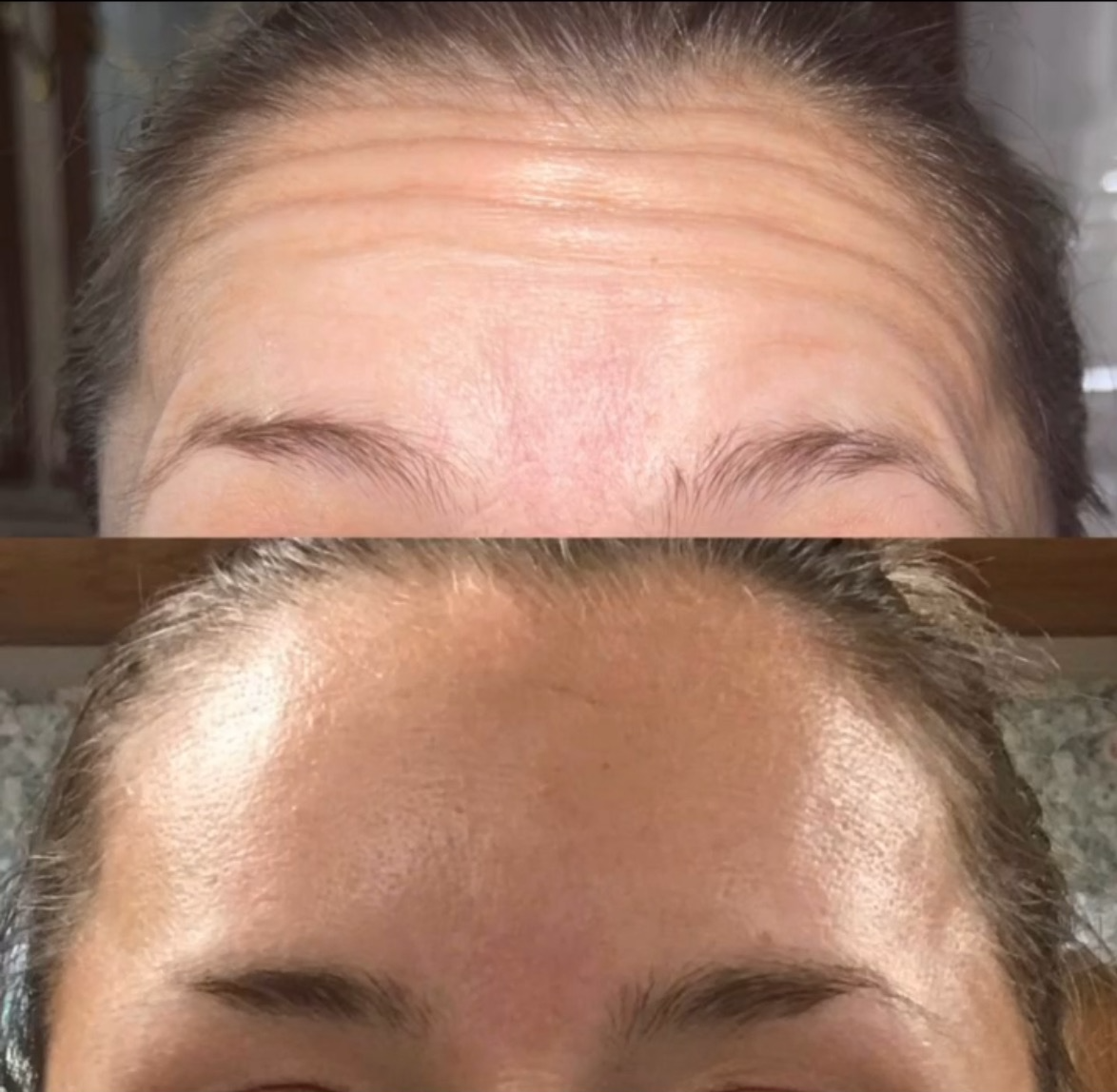
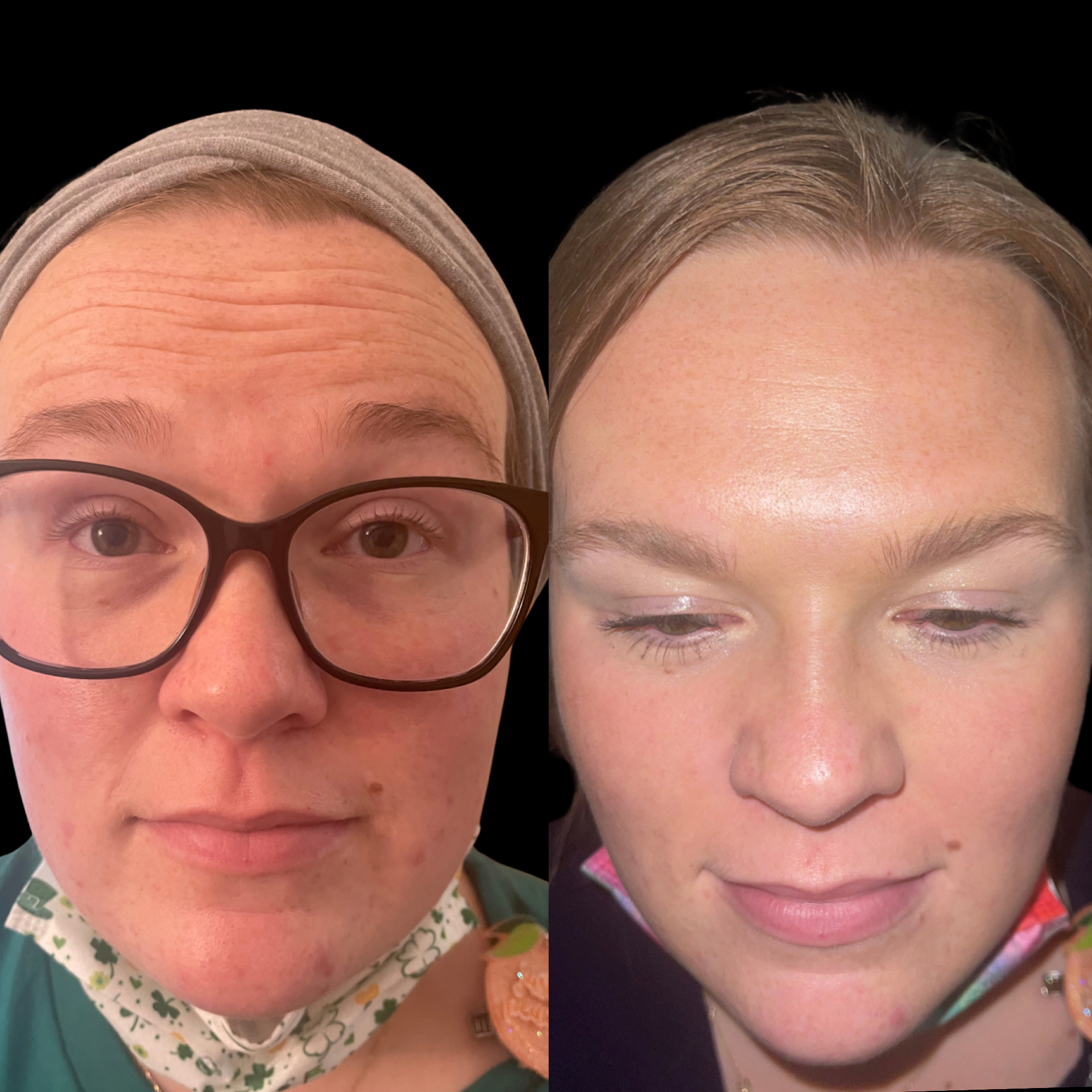
Before
& after.
Actual Tulua patients. Photos taken in clinic — no filters, no retouching. Individual results vary.
All images shared with written patient consent.
— Questions
Your questions,
answered.
Don't see your question? Bring it to your complimentary consultation — we love the curious ones.
- Can I just get my 11s treated?
- We don't routinely treat the glabella as an isolated area. The glabellar complex pulls the brows down while the frontalis pulls them up — weakening one side of that relationship without assessing the other can change brow position and how your expression reads. We assess both, then decide together what gets treated.
- Can I just get forehead Botox?
- The frontalis is the only muscle lifting your brows; the glabellar complex and orbital muscles pull them down. Softening the frontalis alone can leave the depressors relatively more dominant, which may lower or flatten the brow. That's why forehead dosing is planned in relationship to the glabella rather than on its own.
- Can I only treat my crow's feet?
- Lateral eye movement is part of a larger upper-face pattern involving the brow and glabella. We evaluate that whole pattern first — sometimes crow's feet alone is the right plan, but that's a conclusion from assessment, not a starting assumption.
- Why do you treat the DAO and chin with full-face tox?
- The DAO pulls the mouth corners downward and an overactive mentalis creates chin dimpling and lower-face tension. These depressor muscles shape how the lower face reads at rest. Including them is what allows the upper and lower face to look like the same face.
- Why don't you charge strictly by the unit for every treatment?
- Because muscle size, strength, anatomy, metabolism and prior exposure mean two people with the same concern can need very different dosing. For lip flip, masseter/temporalis and trap tox we charge a flat treatment price based on the result, so the plan is driven by your anatomy rather than a unit count.
- Will full-face tox make me look frozen?
- No. Comprehensive doesn't mean eliminating movement. The goal is strategic modulation — softening dominant muscles, respecting their opposing groups and preserving the expression that makes your face yours.
- How many units of neurotoxin will I need?
- It's individualised. The starting-dose chart above shows typical ranges by area, but your actual dose is determined at assessment based on anatomy, muscle strength, movement patterns, prior response and your goals. We won't quote a guaranteed number before we've seen your face move.
- Is full-face tox for everyone?
- No. Every patient is assessed individually, and treatment may be modified, deferred or considered inappropriate depending on anatomy, medical history, contraindications, goals and clinical assessment.
- What's the difference between the neurotoxin brands?
- Botox, Dysport, Daxxify, Xeomin and Jeuveau are all FDA-approved neuromodulators with slightly different diffusion characteristics, onset and duration. Every brand we carry is priced the same — $13 per unit — so the choice is clinical, never financial. We choose based on your anatomy, treatment area and history — not on what's in stock.
- What makes Daxxify different?
- Daxxify is the only neuromodulator stabilised with a peptide instead of human serum albumin, which most other tox brands use. It can last up to 6 months, but it requires a higher number of units than Botox or Dysport — so at the same $13 per unit, the treatment total is higher. It suits patients who want fewer visits per year and are comfortable with the higher unit count.
— Your next step
Start your transformation —
book a free consultation today.
Join 200+ East Valley patients who chose natural, proportional results.
Start with a complimentary 45-minute consultation. We'll perform a 3D skin analysis, answer every question and design a personalised plan — no consult fee, no card on file.
Same-week appointments available · Book your free 45-min consultation
Or call (480) 485 — 4975
— Also in Injectables